Our breath, mind and body are all linked so that an action impacting one brings about change in the other. You will have noticed that you feel tired and sluggish after a day sat slumped in front of your computer, or a few hours in front of the TV. This is because poor posture leads to shallow breath. Our breath feeds the body with oxygen, because of this we need to ensure that we are breathing properly to function at our best. In doing so we can even extend our life.
“Mammals with the lowest resting heart rates live the longest. And it’s no coincidence that these are the same mammals that breathe the slowest. The only way to retain a slow resting heart rate is with slow breaths.”
James Nestor ‘Breathe: The New Science of a Lost Art’
B.S.K Iyengar wrote that “The yogi’s life is not measured by the number of his days, but by the number of his breaths,”. He knew this first hand as an Indian yoga teacher who spent his childhood bedridden and cured himself through yoga and his breath. He breathed himself back to health and lived to 95.
Clear thoughts and physical and emotional balance arise from controlled breath. In yogic teaching these practices are known as ‘pranayama’; ‘prana’ meaning breath and ‘yama’ meaning regulation or control.
“We should be conscious of the 25,000 inhales and exhales we take daily. “
James Nestor ‘Breathe: The New Science of a Lost Art’
Types of Pranayama
Popularised by ‘mindfulness’ and ‘headspace’ probably the most recognisable pranayama technique is Alternative Nostril Breathing, known in sanskrit as Anuloma Violoma or Nadi Shodana. It is exactly what the name suggests – breathing through each nostril in turn.
Alternative Nostril Breathing can be done by anyone at anytime, which is probably why it is such a popular form of pranayama. One should be cautious and pay attention to how they feel during the practice if they have a cold or flu.
It has many benefits including improving oxygen supply, purifying the blood increasing concentration, reducing feelings of stress and boosting your immune system.
How to do it? Sit in a cross legged position, or another comfortable seat with your spine straight. Eyes closed. Bring your left hand on top of your knee (if in cross legged position). Raise your rights hand. Tuck your right elbow into your side. Fold in your right and middle finger to your palm. You will be using your thumb to close your right nostril and your ring finger to close your left.
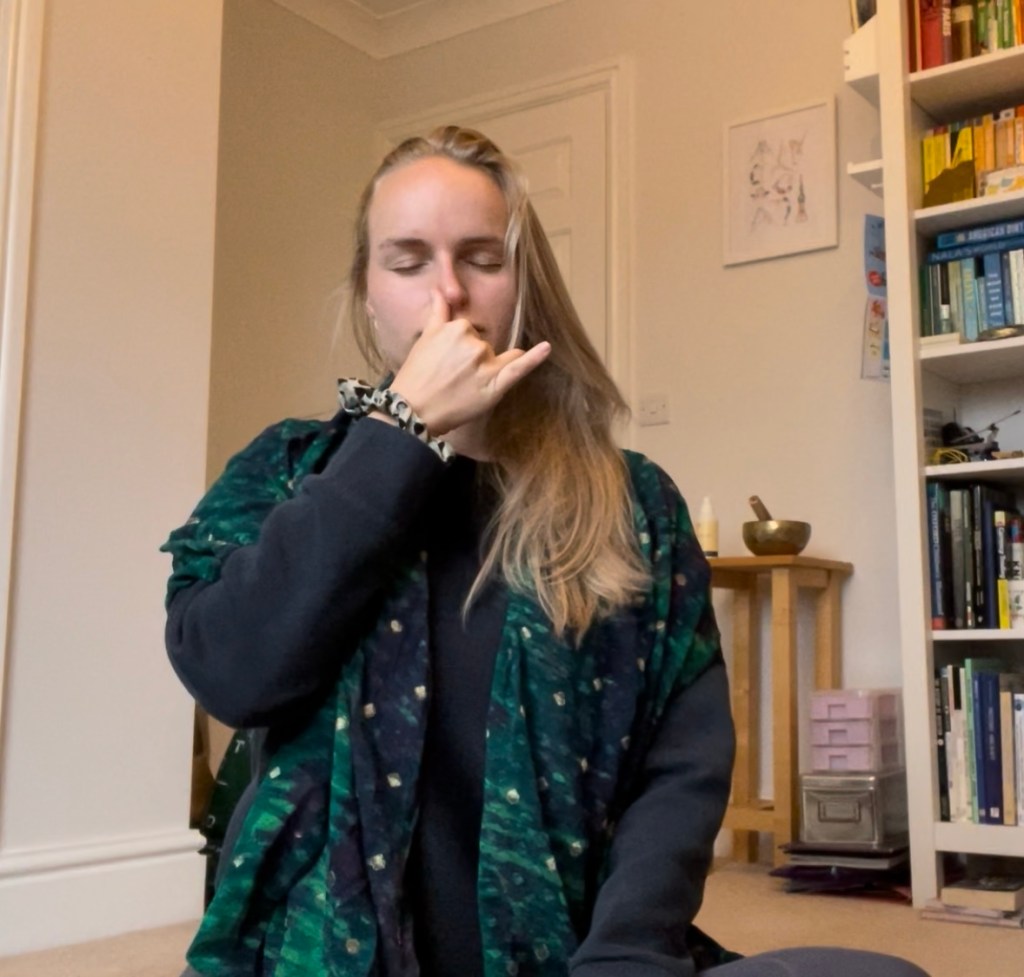
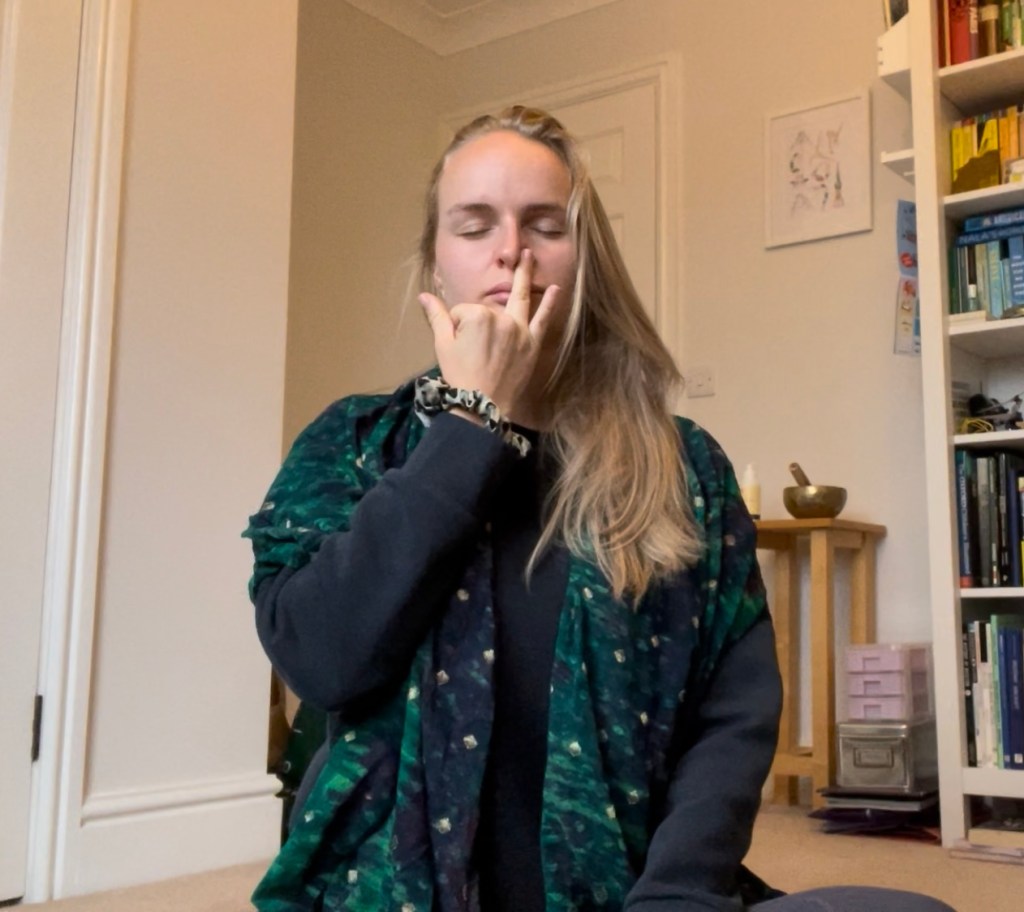
First, with your thumb over your right nostril inhale for 5 counts from your left nostril. Then, close your left nostril with your ring finger and exhale for 5 counts through your right nostril. Next, inhale for 5 counts through your right nostril. Finally, place your thumb on your right nostril and exhale for 5 counts from your left nostril. This is one round. It is recommended to practice for 10 rounds to feel the effects. You can do so more or less.
Another form of pranayama is Skull Shining Technique, known as Kapalabhati in sanskrit. This technique requires strong exhalations and abdominal contractions which result in toxins being removed from the body and new oxygen being brought in to purify the bloodstream and rejuvinate our bodily tissues.
Skull Shining Technique should not be practiced by anyone who has high blood pressure, heart disease, epilepsy, or during pregnancy. Due to the strong exhalations it is best practiced on an empty stomach.
Benefits of this technique include cleaning of the brain and respiratory system. This is what inspired it’s english name ‘Skull Shining Technique’. It also increased lung capacity, improves the expulsion of carbon dioxide and absorbtion of oxygen. Additional benefits include toning of the abdominal muscles, and an increase in metabolic rate.
How to do it? Sit comforably with a straight spine. Place your hands on your knees (if seated cross-legged). Chin slightly lifted and eyes closed. With each exhalation, sharply contract your abdominal muscles forcing the air out of your lungs. Your shoulders should remain in the same position throughout as the inhale is passive. Relax your face. Repeat for a cycle of 20 breaths. For best results do 3 rounds of 20.

With practice the speed of these breath can increase and the rest between each set can be reduced.
The final form of pranayama I’m covering today is without a doubt my favourite. It is known as the Humming Bee Technique, or Bhramari. It’s name comes from the sound produced which sounds just like bees humming, especially when done in a large class or busy Yoga Shala.
The only reason one should not practice the Humming Bee Technique is if they are suffering from an ear infection, or have recently undergone surgery on their ears.
Humming Bee Technique, just like the other pranayamas, has many benefits. It relieves stress, reduced blood pressue, strengthen and improved the voice, eliminated throat ailments and sooths the mind.
How to do it? Sit in a comfortable pose with your spine straight and eyes closed. Take a few normal breaths to centre yourself ready for the practice. Bend your elbows raising your arms so they are parallel to the floor. Move your elbows slightly out to open your chest. Stretch out your fingers and place them on your head. Place your thumbs lightly on top on the flaps of your ears. You will use your thumbs to close them.
Breathe deeply through your nose. Close your ears. Hum smoothly with your exhale. Repeat 5-10 times before removing your hands and opening your eyes.
For more yoga tutorials and calm find me on Instagram (@calm_collective_yoga) and YouTube.
 Calm Collective Yoga
Leave a comment